PRP vs Cortisone for Knee Pain: Which Is Better?
H1: PRP vs Cortisone for Knee Pain: What’s the Difference?
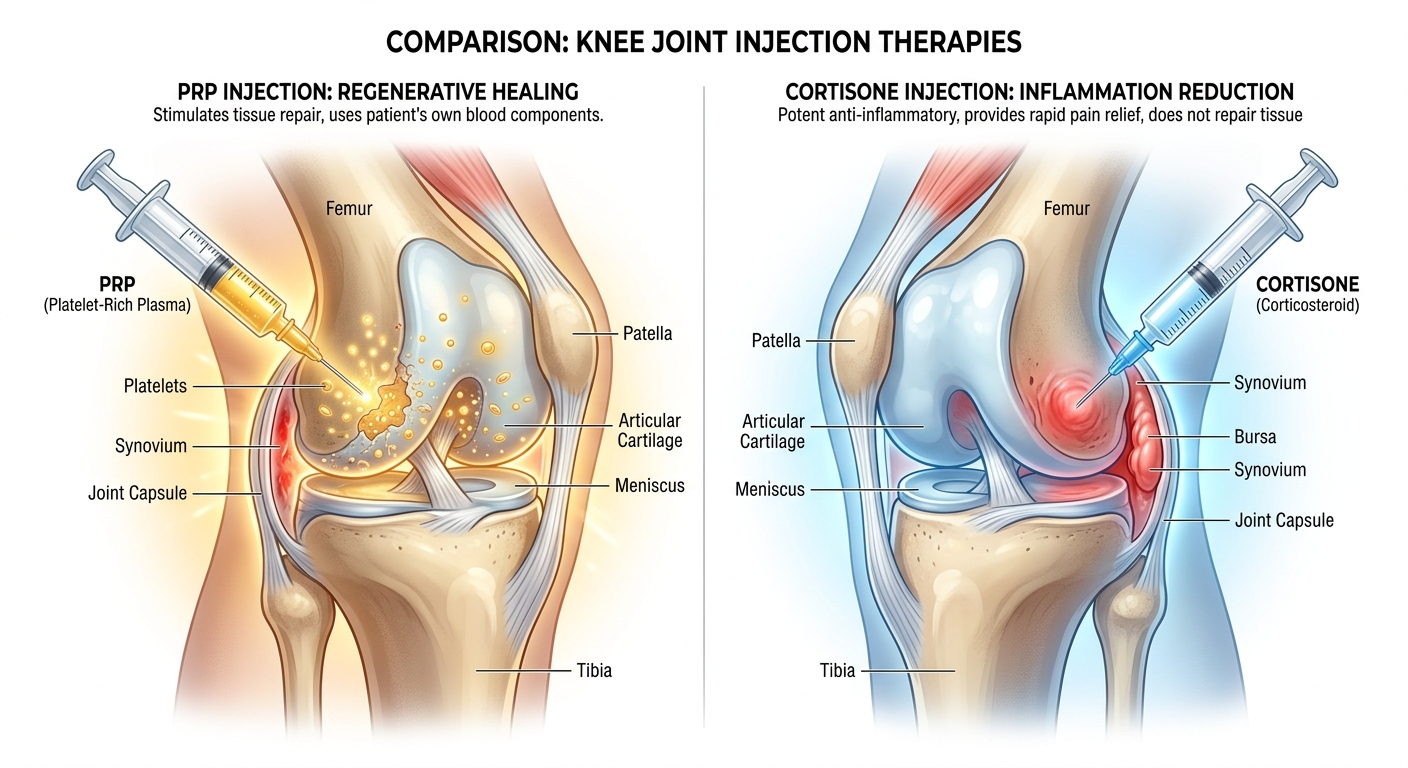
If you’re dealing with knee pain, especially from arthritis or a chronic injury, you’ve likely heard about cortisone injections.
More recently, you may have heard about PRP (Platelet-Rich Plasma).
Patients often ask the same question:
“Which one is better?”
The answer depends on your goals — and understanding the difference is critical.
What Cortisone Injections Actually Do
Cortisone is a powerful anti-inflammatory medication.
When injected into the knee, it works by:
Reducing inflammation quickly
Decreasing pain
Improving short-term function
For many patients, cortisone can provide fast relief, sometimes within days.
However, it’s important to understand:
➤ Cortisone does not heal tissue
➤ It is designed to manage symptoms
For some patients, repeated cortisone injections may even contribute to tissue breakdown over time.
What PRP Does Differently
PRP (Platelet-Rich Plasma) is created from your own blood.
We concentrate the platelets and inject them into the knee under ultrasound guidance.
Platelets contain growth factors that:
Support tissue repair
Improve joint environment
Promote long-term healing response
Unlike cortisone:
➤ PRP is not about quick relief
➤ It is about supporting your body’s healing process
Short-Term vs Long-Term Thinking
This is where most patients get confused.
Cortisone is:
Fast
Temporary
Symptom-focused
PRP is:
Slower
Longer-lasting (in appropriate patients)
Healing-focused
If your goal is only short-term pain relief, cortisone may make sense.
If your goal is long-term function and avoiding progression, PRP may be a better option.
Which Patients Do Better With PRP?
PRP tends to work best in:
Mild to moderate arthritis
Active patients
Patients who want to avoid or delay surgery
Patients who have failed basic conservative care
PRP is not ideal for:
Severe, end-stage bone-on-bone arthritis
Patients expecting instant results
Why Proper Diagnosis Matters More Than the Injection
This is where most clinics get it wrong.
They treat:
➤ the symptom (pain)
Instead of:
➤ the cause of the pain
At Joint Vitality Institute, we start with:
A full evaluation
Imaging when needed
Understanding joint mechanics
Because not all knee pain is the same.
And not all patients benefit from the same treatment.
➤ Learn more about Platelet-Rich Plasma (PRP) therapy
So… Which One Should You Choose?
There is no universal answer.
The right choice depends on:
Your diagnosis
Your goals
The condition of your joint
What matters most is not choosing a treatment…
It’s choosing the right treatment for the right patient at the right time.
Start With a Real Evaluation
If you’re considering PRP or cortisone, the first step is understanding your specific condition
